
Wi-Fi vs. 5G: Two superheroes in the world of Internet of Things (IoT). They continuously compete to be the fastest and most reliable, while all you care about is buffer-free streaming?
Jokes aside, both of these wireless internet technologies are meant to coexist, as one cannot entirely replace the other. The main difference between Wi-Fi and 5G is how they provide internet access, and that determines your choice in a given situation.
Still confused? Let’s dive into a detailed 5G vs. Wi-Fi comparison so you can easily tell them apart.
What Is Wi-Fi and How Does It Work?
Wi-Fi is a localized wireless network that relies on a router inside your home, a building, or any enclosed space. The router is connected to a modem that converts analog signals from your internet provider into digital signals that can be understood by your device.
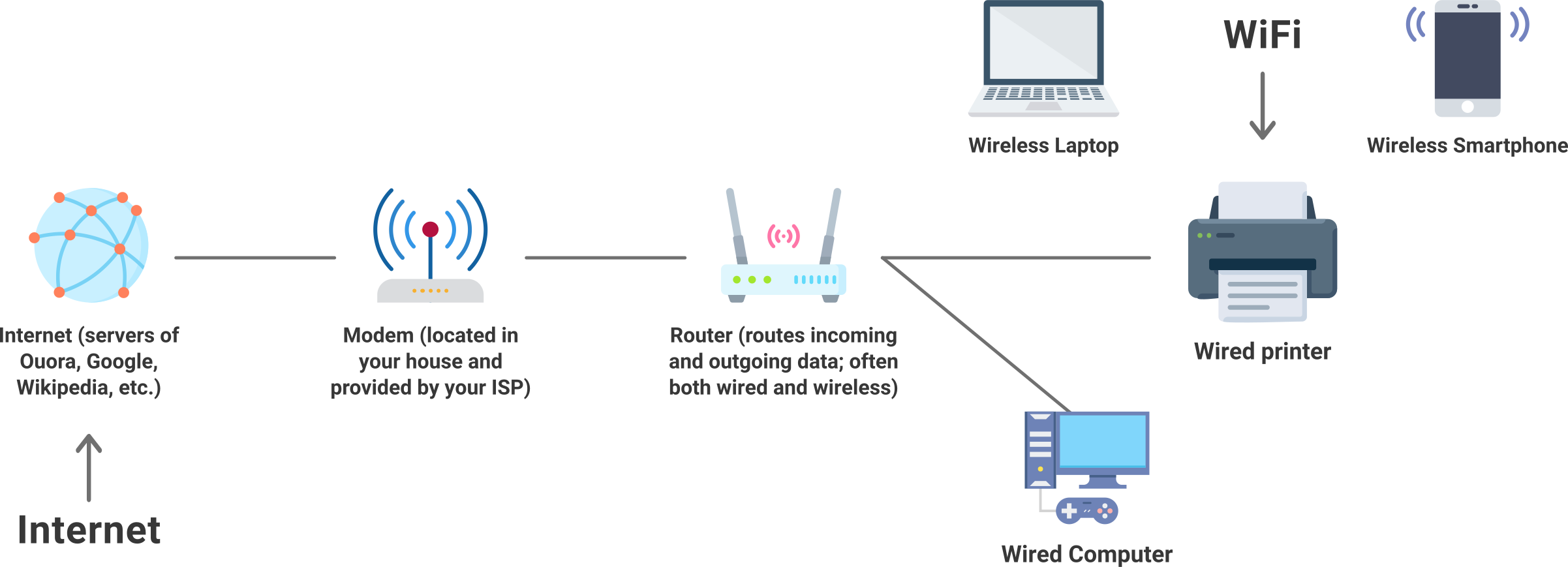
The router creates a local area network (LAN) to connect multiple devices via Wi-Fi or Ethernet. Data is transmitted over Wi-Fi using radio waves within a 30-meter radius; the Wi-Fi range can be more or less, depending on the capacity of the router.
What Is 5G and How Does It Work?
5G represents the fifth generation of cellular technology, so you can call it the successor of 4G mobile connectivity. Compared to 4G, 5G offers a lot more bandwidth, greater speeds, and overall improved performance – it has truly revolutionized mobile networks.
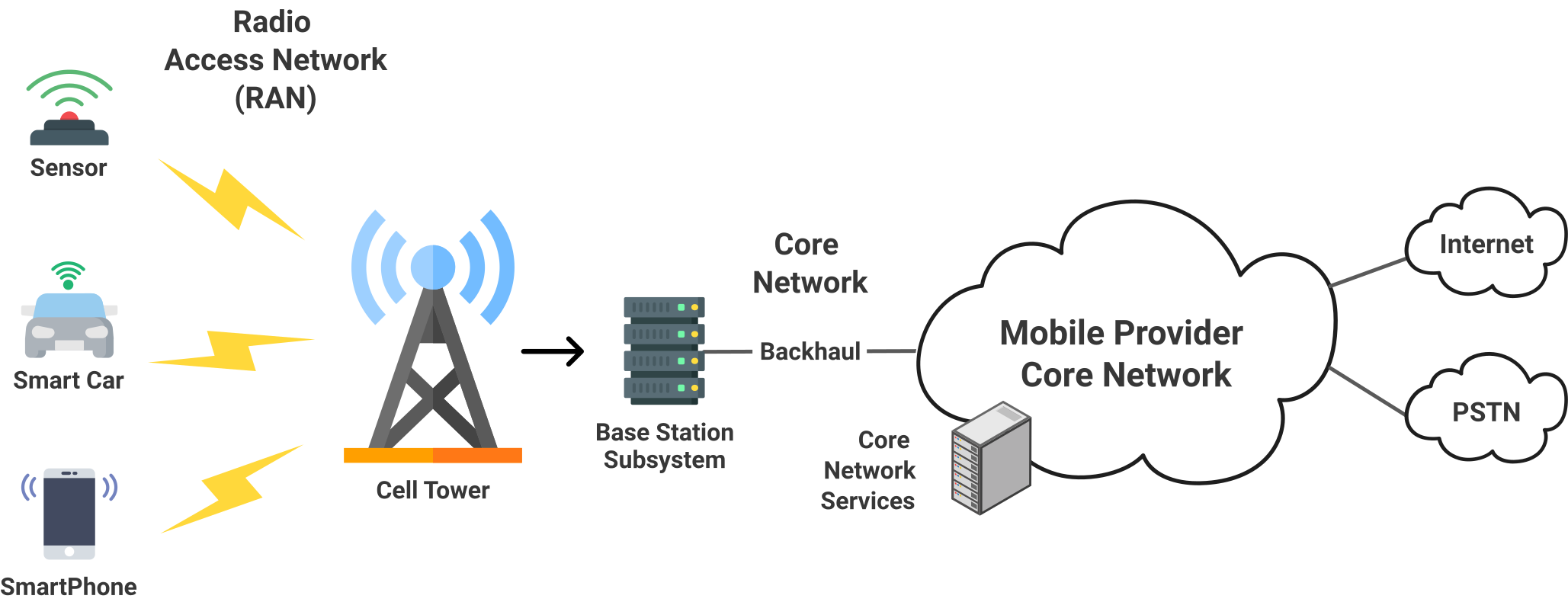
5G provides SIM-based connectivity and relies on a vast network of cellular towers or cell sites. Devices within 500 meters of a cell site can connect with a compatible SIM card; data is sent and received via radio waves.

What is 5G Home Internet?
Several cellular service providers are selling 5G Home Internet plans as an alternative to conventional wired broadband. Similar to 5G mobile data, 5G Home Internet works with a SIM card integrated in a receiver that is fitted in your home.
The receiver connects to a modem and router inside your home to create a localized network, as with other residential broadband services.
Wi-Fi vs. 5G — Key Differences
| Feature | Wi-Fi | 5G |
|---|---|---|
| Speed | Depends on your internet plan and router capabilities; you can achieve multi-gigabit speeds. | Theoretically, it can deliver download speeds up to 20 Gbps. In reality, typical speeds range between 100 – 300 Mbps. |
| Coverage | Limited to your home; the network range is up to 150 feet on average. | The network range of a 5G cell station is up to 3 miles. |
| Latency | Depends on the type of connection; fiber internet offers ultra-low latency. | Latency of 5G is comparable to fiber-optic under ideal conditions (between 1 -10ms). |
| Cost | Relatively cheaper, but the actual cost varies by internet setup. | It can be expensive if you pay per GB of data. |
| Security | Private home Wi-Fi networks maximize local control over security settings. | Primary relies on carrier-level security with advanced encryption and data protection. |
Speed Comparison — Is 5G Faster Than Wi-Fi?
5G is the fastest generation of mobile internet yet, which makes it ideal for high-speed internet access on the go. On the other hand, the latest (Wi-Fi 6 and above) are built for improved capacity and efficiency, so they don’t fall short on speed either.
While theoretical speeds of 5G are up to 20 Gbps, practical speeds hardly reach 1 Gbps. All the same, you can enjoy multi-gigabit speeds on Wi-Fi with a premium fiber internet plan and a cutting-edge router. The achievable speeds with 5G and Wi-Fi 6 are comparable at present, so let’s call it a tie.
Coverage & Reliability — Which One Works Everywhere?
5G internet can be converted to Wi-Fi using a modem and router, but this doesn’t work the other way around. Since every type of internet connection can be used to create a Wi-Fi network, it’s safe to say that Wi-Fi works everywhere.
5G networks are rapidly expanding across the US, but they’re still a long way from completely replacing 4G LTE. Compared to Wi-Fi routers, 5G cell sites have better range, and that makes them the superior choice for outdoor use; Wi-Fi is more practical for indoor usage.
Urban vs. Rural Connectivity
Despite limited coverage, 5G internet is a fairly reliable internet option for rural areas that lack access to wired broadband services.
In contrast, fiber or cable connections are far more reliable and easily available in urban zones. However, 5G Home Internet is gaining popularity among apartment dwellers in big cities, owing to the convenience offered by its wireless infrastructure.
Wi-Fi vs. 5G for Home Internet
Wi-Fi is an essential for every household that contains multiple internet users and smart home devices. Whether you go for fiber/cable internet or 5G Home Internet, you can set up a capable Wi-Fi network by signing up for a suitable plan - unlimited data and download speeds up to 300 Mbps or above should do the trick.
Wired broadband is known for providing a stable connection and consistent speeds. On the contrary, the performance of 5G Home Internet depends on the proximity of a cell station to your home.
Furthermore, 5G Internet is relatively susceptible to signal interference from weather, electromagnetic waves, physical barriers, etc. At the end of the day, Wi-Fi from a wired broadband service can offer a better user experience for streaming, gaming, and other online activities.
Wi-Fi vs. 5G for Gaming & Low Latency Performance
5G Internet can be a decent option for gaming on your mobile devices on the go. However, fluctuations in speed and latency are to be expected with mobile internet.
An Ethernet connection is the best solution for online competitive gaming on your PC, console, or other gaming device. Wired connections offer better speeds, lower latency, and packet stability, so you don’t experience lag during gameplay.
Then again, if you have to play games on Wi-Fi, make sure you’re close to the router and the signals are strong. Choose the 5 GHz or 6 GHz Wi-Fi band for a faster and steadier internet connection.
Security Comparison — Which Is Safer?
Both 5G and modern Wi-Fi standards come with powerful network security features, yet none of the two is 100% risk-free. Here’s an overview of how these wireless internet technologies protect your devices from cyber threats:
5G Security Features
- Strong 256-bit encryption algorithms to complicate your online traffic and make it nearly impossible to intercept
- Dynamic authentication protocols to verify the identity of users and devices
- Security Edge Protection Proxy (SEPP) – protects user data while roaming/switching between networks
- Network slicing – creation of multiple virtual networks to isolate potential malware attacks
Wi-Fi Security Features
- WPA2/WPA3 encryption protocols to evade online and offline attacks
- Password protection – long and complex passwords are harder to guess and hack
- Network segmentation – creation of an alternate/guest network so the primary one remains inaccessible to visitors/outsiders
- MAC address filtering – fortifies the home network by limiting access to a list of saved MAC addresses
Wi-Fi and 5G incorporate a unique set of security features that align with their specific infrastructure and target environments. Most of the mentioned features are controlled by the user, and each technology is prone to different kinds of cyberattacks; hence, there’s no winner in this scenario.
Cost & Data Usage Differences
Why depend on Wi-Fi when you can directly connect to 5G networks from your smartphone? The truth is that relying on mobile data entirely would be too expensive and inconvenient. Most home internet plans come with unlimited data or a generous data cap, which isn’t the case with cellular plans.
Most 5G mobile plans offer limited high-speed data; you’re stuck with slow speeds once you’ve consumed your monthly quota. Although 5G Home Internet plans can offer uncapped data/soft data cap for residential use at affordable rates.
Top 3 5G Home Internet Providers
| ISP | Download Speed | Upload Speed | Starting Price | How to Get |
|---|---|---|---|---|
 | 90 – 300 Mbps | 8 – 30 Mbps | $60.00/mo. (Plus taxes1) | CALL NOW |
 | Up to 300 Mbps (typical speeds of 85 to 250 Mbps) | 5 – 75 Mbps | $35/mo.2 | CALL NOW |
 | 87 – 415 Mbps | 12 – 56 Mbps | $503 | CALL NOW |
1. Price after $5/mo. AutoPay discount (w/in 2 bills). Paperless billing required. Monthly State Cost Recovery charge applies in OH, NV, TX.
2. w/ Auto Pay & any Verizon mobile phone plan See Details
Consumer data usage is subject to the usage restrictions set forth in Verizon's terms of service; visit: https://www.verizon.com/support/customer-agreement/ for more information about 5G Home Internet or https://www.verizon.com/about/terms-conditions/verizon-customer-agreement for Fios internet.
3. with AutoPay, taxes and fees included.
Delivered via 5G cellular network; speeds vary due to factors affecting cellular networks, including data prioritization.
Final Verdict: Which One Should You Use?
Different situations call for different solutions, so here’s what you can do:
- General home use → Wi-Fi
- On the go/outdoors → 5G
- Competitive/Multiplayer Gaming → Wi-Fi 6 or higher
- Backup solution during outages → 5G mobile hotspot
Wi-Fi 6 vs. 5G — Future Tech Battle
Not to disappoint you, but Wi-Fi and 5G are not contenders in the arena of internet technologies. These are two wireless technologies that complement each other in a world crowded with smart devices and IoT.
While there’s no room for a battle, 5G and Wi-Fi hybrid models can make way for a world that’s better connected. A transition from smart homes to smart cities is something we might witness in the near future.
FAQs
Do I need Wi-Fi if I have 5G Internet?
You can directly use 5G internet on your phone by subscribing to a 5G data plan. However, you will need Wi-Fi to connect and use other devices on the same connection.
Wi-Fi vs. 5G: Which is better?
Wi-Fi is best for internet usage at home, whereas 5G is ideal for staying connected on the go.


