
State-by-State Internet Coverage in the U.S. (2026): Which States Are Best Connected
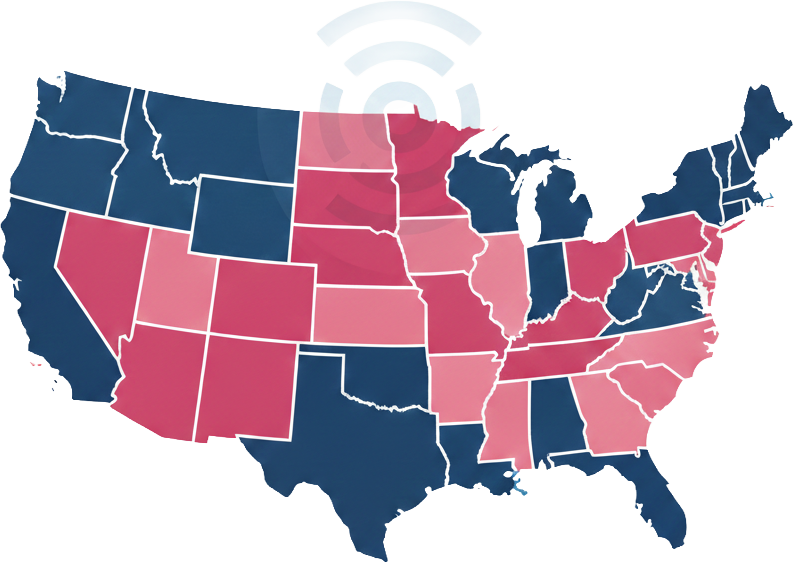
This comprehensive study of state-by-state internet coverage in the U.S. will show you where you stand in this well-connected world.
Internet coverage and average speeds in your state influence digital equity, economic opportunities, education, remote work, and more. Has broadband access in your area improved in 2026, or are you stuck with the short end of the stick?

Find Top Internet Providers Near You
Enter your zip code to explore your best options now!
Fiber availability, 5G coverage, access to other types of broadband services, maximum achievable speeds, and affordability of internet across a state determine how it ranks – so let’s get started!
Key Findings
- The number of states receiving the minimum standard of broadband speeds (100 Mbps download and 20 Mbps upload) has increased from 22 to 38.
- Only 5 states (Connecticut, Delaware, New Jersey, North Dakota, and Rhode Island) are delivering minimum broadband speeds to 70% or more consumers.
- The digital divide is most prominent in Alaska, Illinois, Oregon, and Washington.
- 46% of the U.S. (nearly 75 million households) have access to fiber internet.
- Almost 50% of urban households are eligible for a fiber internet connection .
- Only 38% rural households are served by fiber internet providers.
- New York has the largest urban-rural gap for fiber availability.
- New Jersey ranks #1 in overall internet coverage and performance.
- The cost of the internet is at least 30% higher in rural areas.
- About one-fourth of consumers are subscribed to internet plans with speeds of 500 Mbps or above.
- Rhode Island has the biggest fiber footprint with roughly 80% coverage.
- Alaska has the lowest fiber internet coverage.
- Iowa has the most competitive broadband market with 203 internet service providers (ISPs).
- The average internet speed nationwide is about 214 Mbps.
Top States for Internet Coverage & Performance 2026
The top ten states with maximum internet coverage, great speeds, and affordable pricing are as follows:
| State | Estimated Internet Coverage (Wired + Fixed Wireless) |
|---|---|
| New Jersey | 97% |
| Maryland | 96% |
| Delaware | 95% |
| Connecticut | 93% |
| New Hampshire | 92% |
| Massachusetts | 91% |
| Texas | 89% |
| Rhode Island | 88% |
| Florida | 87% |
| New York | 85% |
Therefore, if you’re looking to move to a state with unbeatable internet performance and accessibility, you may take your pick from the table above.
Here’s the highlight of broadband services in each state:
- New Jersey – scores perfectly in every department, including availability, cost, and overall performance
- Maryland – low-latency internet with impressive upload speeds
- Delaware – exceptional download speeds
- Connecticut – nearly 75% fiber internet coverage
- New Hampshire – fastest speeds nationwide
- Massachusetts – many internet options
- Texas – highly competitive market with 195+ providers
- Rhode Island – biggest fiber footprint
- Florida – digital divide/urban-rural gap is minimal
- New York – lowest latency scores
Worst/Most Underserved States
Now let’s talk about the states that scored the least in terms of internet coverage, performance, and affordability:
| State | Estimated Internet Coverage (Wired + Fixed Wireless) |
|---|---|
| Alaska | 27% |
| Montana | 46% |
| Wyoming | 55% |
| Idaho | 55% |
| Kansas | 60% |
| West Virginia | 61% |
| Louisiana | 63% |
| New Mexico | 64% |
| Hawaii | 65% |
| Vermont | 66% |
Low internet coverage often means fewer internet options and higher charges; the type of available connections and user density impact speeds.
Here’s why broadband services in the mentioned states get a poor score:
- Alaska – less than 1% of the population has access to affordable broadband, and fiber internet coverage is lowest
- Montana – high prices for rural households and slow speeds
- Wyoming – significant cost difference for urban and rural users
- Kansas – extensive rural territory and underdeveloped internet infrastructures
- West Virginia – mountainous landscape restricts deployment
- Louisiana – median speeds are below average
- New Mexico – severe digital divide
- Hawaii – lack of infrastructure due to geographic isolation
Fiber Availability by State
Fiber internet is the fastest and most reliable form of broadband nationwide. However, states with the largest fiber-optic networks do not necessarily make the list of top performers.
| State | Estimated Total Fiber Coverage | Urban Availability | Rural Availability |
|---|---|---|---|
| Rhode Island | 80% | 81% | 72% |
| Nebraska | 69% | 78% | 50% |
| Connecticut | 64% | 65% | 58% |
| North Dakota | 64% | 42% | 90% |
| New Jersey | 63% | 65% | 36% |
| New York | 63% | 68% | 32% |
| Tennessee | 61% | 62% | 60% |
| Kansas | 60% | 64% | 52% |
| South Dakota | 60% | 45% | 77% |
| Utah | 60% | 62% | 45% |
Almost 70% of households within the listed states above have access to fiber internet service. Urban households typically occupy the major share, since deployment is easier in developed areas.
Fiber internet infrastructures are expensive, but the high demand for services in densely populated urban neighborhoods makes up for the cost. In contrast, rural areas have low demand because of limited inhabitants; hence, fiber ISPs are uncommon.
Despite the urban-rural gap, regional providers like Kinetic and Ziply Fiber are taking the initiative to improve rural connectivity by extending their fiber networks to these areas.

Now let’s take a look at states with the lowest fiber availability:
| State | Estimated Total Fiber Coverage | Urban Availability | Rural Availability |
|---|---|---|---|
| Alaska | 9% | 6% | 14% |
| New Mexico | 18% | 16% | 23% |
| Arizona | 21% | 22% | 19% |
| Michigan | 26% | 26% | 25% |
| Nevada | 26% | 26% | 26% |
| West Virginia | 29% | 42% | 19% |
| Montana | 30% | 25% | 36% |
| Wyoming | 31% | 35% | 24% |
| Illinois | 31% | 31% | 29% |
| Idaho | 32% | 38% | 20% |
Limited fiber connectivity mainly owes to geographical challenges, high cost of deployment, and low return on investment (ROI) for ISPs. Satellite internet is generally more suited for remote and secluded regions, though it can be relatively expensive.
On another note, states that have the least internet coverage, a wider urban-rural gap, and/or comparatively low fiber availability tend to receive higher funding from the Broadband Equity, Access, And Deployment (BEAD) program .
Role of BEAD
BEAD is a federal program, with over $42 billion in funds, that aims to bring affordable high-speed internet to all states and territories across America.
The program primarily supports rural and other underserved regions to eliminate the digital divide. BEAD’s resources back the building of fast and reliable internet structures to improve access nationwide.
Considering the generous allocation of funds, internet coverage, overall performance, and cost for consumers are predicted to improve significantly in the next few years.

Speed Performance by State
According to Ookla Speedtest Intelligence® data, 38 states and the District of Columbia were delivering the minimum standard of broadband speeds (100 Mbps download & 20 Mbps upload) to at least 60% of speed test users in the first half of 2026.
The data reflects speed tests for wired + fixed wireless internet services. It shows noticeable development from the results of the second half of 2024, which was limited to 22 states and the District of Columbia.
Here’s an overview of states that outperformed in terms of speeds by delivering more than the nationwide median (214 Mbps):
| State | Average Internet Speed 2026 |
|---|---|
| Delaware | 247 Mbps |
| Maryland | 238 Mbps |
| New Jersey | 236 Mbps |
| Connecticut | 234 Mbps |
| Florida | 233 Mbps |
| Virginia | 230 Mbps |
| Rhode Island | 227 Mbps |
| Texas | 226 Mbps |
| California | 224 Mbps |
| Nevada | 221 Mbps |
The findings suggest that states along the Northeast and Southeast of the country enjoy the fastest speeds. These states are relatively smaller in size and have a high population density, which promotes ISP competition.
On the contrary, states with the lowest average internet speeds are largely located in the West and Midwest regions. These areas have a high percentage of rural lands and/or challenging topography (due to hills, mountains, etc.), which makes deployment difficult.
States with the lowest average broadband speeds in 2026:
| State | Average Internet Speed |
|---|---|
| Idaho | 125 Mbps |
| Alaska | 125 Mbps |
| Montana | 130 Mbps |
| Hawaii | 146 Mbps |
| Wyoming | 147 Mbps |
| Iowa | 151 Mbps |
| Minnesota | 165 Mbps |
| South Dakota | 165 Mbps |
| West Virginia | 165 Mbps |
| Vermont | 166 Mbps |

Check Your Internet Speed Using Our
Free Speed Test Tool
Implications for Consumers
Your location has a huge impact on what kind of internet services are available to you, how the internet performs, and how much it costs you per month.
- Households in well-covered states usually have plenty of wired internet options. The competitive market makes way for lower costs.
- Households in underserved states have fewer ISPs, which results in higher pricing. Lack of wired and fixed wireless services usually means slower speeds.
Tips to Get Affordable, Reliable, and High-Speed Internet
- Use a zip code-based ISP search tool – despite serving your state, many providers may not offer services in your particular neighborhood.
- Compare internet plans and prices from different ISPs in your area to find a service that offers the best value for your money.
- Look up broadband financial assistance and low-income internet plans – you can lower your internet bill if you meet the eligibility criteria
- Advocate locally for more broadband funding/infrastructure if possible.
- Refer to “customer reviews” from users in your area before subscribing to an internet service.

Challenges & Risks
Even though average internet speeds for the U.S. are steadily increasing and BEAD funding is expected to play a vital role in creating digital equity, one cannot overlook the associated risks and challenges:
- Complicated physical geography, high cost of building infrastructure, and funding shortfalls may thwart coverage in certain states.
- The digital divide/urban-rural gap in some states is far too wide to overcome in a matter of a few years.
- Federal Communications Commission (FCC) maps may overreport or present inaccurate info, as it relies on data submitted by ISPs.
- More internet coverage does not guarantee good speeds; poor quality infrastructures are likely to result in substandard service.
Future Outlook
The BEAD program has entered its execution stage, and rumors are that broadband projects for Hawaii, Louisiana, Mississippi, Nevada, and Texas are already in the works.
Additionally, internet expansion proposals for Idaho, Utah, North Carolina, Minnesota, and Massachusetts have also been finalized and approved.
Despite BEAD’s technology-neutral approach, many states are sticking to the fiber-first practice. Since everything remains in the pipeline, one can only make assumptions about the state of affairs in the next five years.
Frequently Asked Questions
How is internet coverage measured in states?
Internet coverage is measured by the FCC through its Broadband Data Collection (BDC) program, which requires internet providers all over the country to report their service areas.
Why do some states have poor broadband coverage?
Some states have poor broadband coverage due to vast rural and underdeveloped lands. These areas often have challenging landscapes and low population density, which makes deployment unnecessarily expensive.
How does BEAD funding affect state broadband coverage?
BEAD-funded projects are still a work in progress, but they are predicted to minimize the digital divide in the next few years. Increasing wired/fixed internet access across all states will improve average speeds and lower costs.
Is fiber available in all states?
Although fiber internet services are available in every state, their coverage area varies. Fiber ISPs mostly operate in densely populated metropolitan areas, whereas rural/remote areas are left behind.
Can I check if my house is covered by high-speed internet?
You can check high-speed internet availability at your address by using provider-specific search tools or the FCC national broadband map..