

Are you considering switching to satellite internet? Better to learn everything about this wireless technology beforehand to save you any inconvenience later.
Satellite internet service is rarely anyone’s first choice, and for good reasons. For starters, it’s a lot more expensive than traditional broadband technologies. Besides that, it’s not exactly as fast and reliable as wired broadband.
Satellite internet usually comes up when cable and fiber internet services are unreachable; to be precise, it is a popular internet option in rural and remote areas of the U.S. The ability to keep people connected where others don’t makes it a powerful and viable solution for millions.
Satellite Internet Pros and Cons at a Glance
Previously, satellite internet was frequently associated with slow speeds and too much lag. However, the technology has evolved with time, and now the full picture depends on the type of satellite internet service you choose:
- Geostationary Earth Orbit (GEO) – traditional satellite technology (offered by Hughesnet and Viasat)
- Low Earth Orbit (LEO) – new and advanced satellite technology (offered by Starlink)
With that in mind, here’s a summary of satellite internet benefits and potential drawbacks:
👍 Advantages of Satellite Internet:
- Widely available in rural and remote areas
- No cable or phone line required
- Easy setup (especially Starlink)
- Faster than DSL in many rural areas
- Enables work from home and telehealth in remote locations
- Portable plans available for travel or mobile homes (Starlink Roam)
- LEO satellites offer low-latency internet (Starlink: 20-40 ms)
👎 Disadvantages of Satellite Internet:
- High latency on GEO satellites (600+ ms)
- More expensive than wired broadband
- Data limitations on select plans
- Signals weaken/deflect due to weather interference and physical obstructions
- Upload speeds are much lower than download speeds
- High upfront equipment costs may apply ($349+ for Starlink)
Find out what satellite internet options are available at your address.
Try Our FREE Zip Code-Based Search Tool for Accurate Results

How Satellite Internet Works
Similar to other broadband connections, a satellite internet setup includes a modem and router in your home. The modem connects to a satellite dish mounted on the roof of your home. When you use the internet on your device and send a data request, the satellite dish on the roof transmits a signal to a satellite in space.
The satellite in space then sends a signal to a ground station connected to your internet service provider (ISP). This ISP network hub or ground station establishes a connection with a server or website on the internet to obtain the requested information.
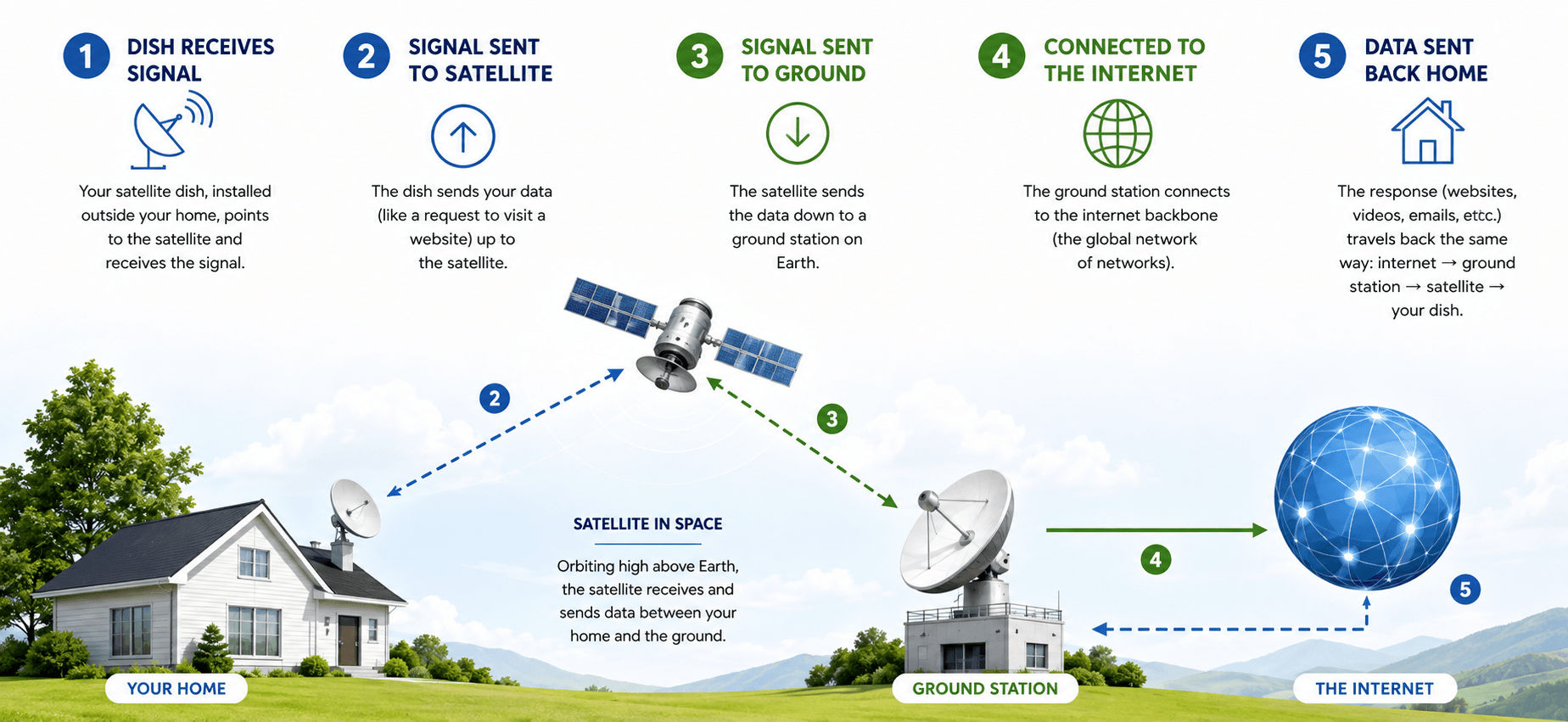
As a result, a data response is issued from the web to your ISP, so the signal makes a round trip using the same path as before, i.e., ground station to space satellite to satellite dish mounted on your roof to the internet modem inside your home.
Since data signals have to travel a long distance to make the round trip, there’s a significant delay between request and response; this phenomenon is described as high latency or ping. That said, the introduction of LEO satellite technology has been a game-changer.
LEO vs. GEO Satellite: Different Technologies, Different Tradeoffs
GEO satellite technology came first, followed by LEO satellite technology that can be considered the “2.0 version”. When browsing satellite internet providers, it’s vital to understand what orbit they operate in, as this will significantly impact your home network’s performance.
Here’s a comprehensive breakdown of both technologies, so you are fully aware of the benefits and trade-offs before making your choice:
GEO Technology
GEO satellites in space are located at high altitude (20,000+ miles) and rotate in sync with the Earth, which makes them appear perfectly stationary. These satellites are massive, and a single one is enough to broadcast signals to nearly one-third of the globe.
Signals that travel from the satellite dish or antennas on Earth have to travel a long distance to connect with the GEO satellite in space. This creates a delay between data request and response, which is noticeable as “lag” in real-time applications (online gaming, Zoom calls/meetings, etc.)
LEO Technology
LEO satellites sit relatively close to the Earth's surface at a distance ranging between 100 and 1200 miles. These satellites are smaller and constantly move at high speeds; they can orbit the Earth in under two hours.
The proximity to Earth enables signals to travel much faster, which eliminates the high-latency issues associated with GEO satellite internet. While LEO satellite internet is suitable for real-time and high-bandwidth activities like video conferencing and multiplayer gaming, the trade-off lies in the infrastructure.
LEO satellites have a small footprint, and thousands of them are launched into space to form a huge constellation. The satellite dishes or antennas on Earth cannot rely on a single satellite in space to maintain connectivity.
In summary, complex groundwork is required to make this system work, which makes it more expensive than traditional GEO technology.
LEO vs. GEO Satellite Internet: A Side-by-Side Comparison
| Feature | LEO Satellite Internet | GEO Satellite Internet |
|---|---|---|
| Top ISPs | Starlink | Hughesnet, Viasat |
| Latency (Ping) | Low (20–40 ms) | High (600+ ms) |
| Real-Time Performance | Excellent for gaming and video calls | Challenging (noticeable lag) |
| Primary Advantage | High speeds and low latency | Widespread availability and lower cost |
| Overall Speeds | Comparable to cable/fiber broadband | Good for basic internet use (browsing, emails, casual streaming) |
Pros of Satellite Internet
Satellite internet might not be the favorite among big city dwellers, but it sure does back up residents of rural and remote settlements. Let’s dive deep into the advantages of this wireless internet technology:
1. Available Almost Everywhere (Rural and Remote Coverage)
The strong suit of satellite internet is its reach. While cable and fiber internet services are usually limited to densely populated urban areas, satellite internet is almost everywhere. Accessibility in the most remote and sparsely populated areas makes it an asset for unserved/underserved communities.
2. No Phone Line or Cable Infrastructure Needed
Unlike conventional wired broadband, satellite internet is independent of any cables or copper/coaxial lines running underground or overhead. The wireless infrastructure makes it ideal for people living in off-grid and geographically challenging areas.
3. Faster Than DSL in Many Rural Areas
For a long time, DSL was the only viable broadband option for rural connectivity. However, poor quality/worn out phone lines running long distances often resulted in slow and unreliable internet. Modern satellite technology (especially LEO) can deliver faster internet and guarantee consistent performance.
4. Quick to Set Up
Having to wait days or sometimes weeks for a technician to come and install your internet service can be nerve-wracking. Moreover, it gets worse if the technician has to drill holes, dig a trench, or tear down a wall in the process. Modern satellite internet kits (such as those from Starlink) are designed for quick self-install, which is oh-so convenient.
5. Enables Remote Work, Education, and Telehealth in Underserved Areas
Satellite internet technology has played a significant role in bridging the digital divide. Many rural and extremely remote areas that were completely cut off from broadband services before can now stay connected and gain access to online resources for remote work, education, and telehealth.
6. Portable and Mobile Options Available (Starlink Roam)
Some satellite internet providers, particularly Starlink, go beyond serving a fixed location or single address. Individuals or families who are continuously on the move or live in a mobile home/RV can take their portable satellite dish along and stay connected on the go with a mobile plan like Starlink Roam.
Cons of Satellite Internet
When you have multiple broadband options to choose from, satellite internet may not be the choice. To explain why, here’s a breakdown of the potential disadvantages:
1. High Latency on GEO Satellite (Hughesnet, Viasat)
The primary drawback for users on GEO-based satellite internet plans is the high latency that no engineering can fix. A ping of 600ms or higher significantly deteriorates the experience of real-time activities like competitive gaming and video calls. Despite decent download speeds, users have to deal with connection drops, screen freezes, patchy audio, etc.
2. Weather Can Affect Signal
The satellite dish/signal receiver mounted on the roof of your property requires a clear line of sight to connect with the satellite in space. Therefore, when the skies aren’t clear, the signals may get partially blocked or deflected. Fortunately, modern dishes are better at handling extreme weather conditions like heavy rain/snow, dense fog, and windstorms.
3. Higher Cost Than Wired Broadband
Satellite internet is an expensive technology, which is why the cost of equipment and monthly service is higher than what you pay with traditional or wired broadband. It’s simply a price you have to pay for staying connected in a rural/remote area that lacks more affordable options.
4. Data Caps and Throttling on Some Plans
While Starlink offers unlimited data on most of its residential internet plans, the majority of GEO-based internet plans from Hughesnet and Viasat come with data caps or "priority data" limits. Consuming your data allowance before the end of the billing cycle results in extremely slow speeds for the remainder of the month.
5. Equipment Obstructions (Trees, Buildings)
Since the satellite dish mounted on your property needs a clear view of the sky, physical objects like trees, walls, and nearby buildings can come in the way and disrupt signals. If your home is surrounded by heavy vegetation or tall buildings, you might need extra gear to elevate the dish and establish a usable connection.
6. Upload Speeds Are Lower Than Downloads
Satellite internet is "asymmetric,” which means that upload speeds are much lower than download speeds. Most ISPs prioritize download speeds because they are important for smooth streaming, loading websites, and downloading content. Low upload speeds are problematic when you’re trying to upload large files or host a live video meeting online.
Satellite Internet Pros and Cons by Provider
You probably know the universal advantages and disadvantages of switching to satellite internet all too well by now, and so it’s time to dig deeper and compare pros and cons on a provider level.
Starlink Pros and Cons
👍 PROS:
- Fastest satellite speeds (up to 320 Mbps download speeds)
- Lowest satellite latency (20-40ms)
- Unlimited data on most plans
- No contracts (cancel anytime)
- Mobile plans for RVs and travel (Starlink Roam)
- Self-install in under an hour
👎 CONS:
- High upfront equipment cost ($349+)
- More expensive than wired options
- Speeds can dip during network congestion (peak usage hours)
- Congestion surcharge in some areas ($500 - $1,500)
- Weather and obstructions can affect the signal

Hughesnet Pros and Cons
👍 PROS:
- Most affordable plans starting at $39.99/month
- Nearly nationwide coverage
- Lower entry-level price than Starlink
- Fusion plan adds fixed-wireless to reduce latency
👎 CONS:
- 600+ ms latency makes gaming and video calls painful
- Data caps: speeds are throttled to 1-3 Mbps after exhausting the limit
- 24-month contracts with ETF (early termination fees) up to $400
- Slowest speeds (compared to Starlink and Viasat)

Viasat Pros and Cons
👍 PROS:
- 100% US coverage
- No hard data cap (deprioritization model)
- Free professional installation on most plans
- Lower entry price in many markets
👎 CONS:
- 600-700 ms latency due to GEO technology
- $50/month price hike after first 3 months on some plans
- 24-month contracts with $15/remaining month ETF
- ViaSat-3 launched with technical issues, limited capacity


Compare Starlink, Hughesnet, and Viasat plans side-by-side
How Satellite Internet has Improved Since 2020?
Satellite internet has evolved tremendously since 2020; if your last experience using it was during or before 2020, you’re in for a pleasant surprise.
Back then, GEO-based satellite internet was the only option as LEO satellite internet wasn’t commercially launched until 2022. Both satellite technologies have continuously improved and expanded coverage over the years.
Previously, satellite internet service was sought as a last resort. However, now that LEO technology has overcome the slow speed and high-latency bottleneck, the status has shifted. It is now being integrated with terrestrial broadband services to help alleviate the digital divide.
With a broadband market share worth more than 4.5 billion USD in 2026, satellite internet is now viewed as a valuable resource in rural/remote regions where deployment of cabled internet services is impractical due to the cumbersome costs and geographical challenges.
Is Satellite Internet Right for You?
Still not sure if satellite internet is the right kind of broadband for you? Here’s the straightforward answer:
- If you have access to fiber/cable internet service in your area, stick to it. Wired broadband is generally cheaper, faster, and more reliable, so don’t bother with satellite internet.
- If you’re a gamer or remote worker residing in a rural area that lacks wired broadband, go for a LEO satellite internet provider like Starlink.
- If you need a budget-friendly service for basic internet usage and satellite broadband is the only option, choose a GEO-based service provider like Hughesnet.
FAQs
What are the pros and cons of satellite internet?
The main advantage of satellite internet is its nationwide coverage and widespread availability in rural/remote areas. The potential drawbacks include the high cost and below-average performance compared to terrestrial internet services.
Is satellite internet reliable?
The reliability of satellite internet varies by the type of satellite technology, provider, location, and usage. LEO satellite internet is fairly reliable for high-bandwidth activities and heavy internet usage, whereas GEO satellite internet is good for basic or light internet usage.
What is the main disadvantage of satellite internet?
The primary disadvantage of traditional GEO-based satellite internet is the high latency, which negatively impacts real-time applications. LEO-based satellite internet eliminates the latency issue, but it costs more.
Why is satellite internet so slow?
GEO-based satellite internet can offer decent speeds, but it feels slow or sluggish due to high latency.
Does satellite internet work in bad weather?
Modern satellite equipment is fairly tolerant of adverse weather conditions, but the internet’s performance is influenced by signal interference, deflection, or blockage.
What is the latency of satellite internet?
LEO satellite internet (Starlink) offers low latency ranging between 20–40ms, whereas GEO satellite internet (Hughesnet/Viasat) has high latency (600ms+).
Is Starlink better than traditional satellite internet?
Yes, Starlink offers higher speeds and lower latency with its LEO satellite technology; hence, it is definitely better for users who prioritize performance over cost.
Who should use satellite internet?
Individuals or families residing in rural/remote areas should use satellite internet if wired broadband is unreachable.


