
2026’s Fastest Growing ISPs in the US: Top Providers & What’s Fueling Their Growth

Fiber and Fixed Wireless Access (FWA)/5G Home Internet providers saw impressive growth in 2025, reshaping U.S. internet market dynamics, infrastructure, and competition.
Tracking internet service provider (ISP) expansion across the country is essential for understanding what drives development, as well as identifying gaps in digital equity.
The Broadband Equity, Access, and Deployment (BEAD) program and certain mergers & acquisitions (M&A) within the U.S. telecommunications industry play a vital role in broadband expansion – let’s find out which ISPs are taking the lead.
Criteria for Ranking
The fastest-growing ISPs in 2025 are those that have expanded their footprint and acquired a substantial number of new subscribers. Their capacity growth may owe to significant government funding aimed at building new and improving existing infrastructure.
Data Sources:
- ISP Evaluation
- Public Financial Reports/Earnings
- OpenSignal Insights
- S&P Global Broadband Market Report
- PC Mag
- Broadband Search
- Surveys from the American Customer Satisfaction Index
Note: All information shared in this resource refers to the growth of ISPs between the years 2024 and 2025.
Top Fastest Growing ISPs in the U.S. (2025 Ranking)
| ISP Name | Type of Service Expansion |
Total Subscriptions in 2024 |
Total Subscriptions in 2025 |
Estimated Growth (2024-2025) |
Key Markets |
|---|---|---|---|---|---|
| Starlink | Satellite | 1.4M | 2M | 45% | Rural/remote areas, including Alaska & Pacific regions |
| T-Mobile | FWA | 6.4M | 8M | 25% | Underserved areas in Florida, Texas, Arizona, and the Southeast |
| AT&T | Fiber & FWA | 10M | 11M | 10% | Fiber services focused on urban areas; FWA focused on suburbs and rural areas |
| Verizon | Fiber & FWA | 12M | 12.6M | 5% | New England, Mid-Atlantic, and South Atlantic regions |
| Frontier | Fiber | 2.4M | 2.75M | 15% | New England, East North Central, and South Atlantic regions |
| Google Fiber | Fiber | 3.5M | 4M | 10% | Mountain states, including Idaho, Montana, Colorado, and Nevada |
| Astound | Fiber/Cable | 1.1M | 1.2M | 10% | Pennsylvania, Washington, Oregon, and Illinois |
| Metronet | Fiber | 2M | 3M | 30% | East North Central and West North Central regions |
Disclaimer: All mentioned stats are approximate; actual numbers may vary.
Growth Drivers: Why These ISPs Are Booming
You may have noticed that most ISPs offering fiber and/or fixed wireless (5G Home Internet) are growing their networks at a fast pace. Other than that, satellite internet services (particularly from Starlink) have gained massive popularity in rural/remote areas.
Let’s reflect on the boom of these internet technologies in detail:
Fixed Wireless (5G)
The three leading 5G Home Internet providers, i.e., T-Mobile, Verizon, and AT&T, have added over a million new subscribers in 2025. FWA is considered a more practical and affordable alternative to traditional broadband services; the low-cost 5G plans and easy setup appeal to a wide demographic.
According to Park Associates, FWA is helping bridge the digital divide, and the customer satisfaction rate is higher compared to other connection types. The performance of 5G networks is improving over time and often exceeds cable/DSL in certain aspects, such as upload speed.

Fiber Expansion
Fiber internet is perceived as a future-proof technology, as it can offer symmetrical speeds and the lowest possible latency. From being too costly around the early 2000s, it has transformed into an affordable and reliable internet service for residential and commercial use.
Federal funding and initiatives like the Broadband Equity Access and Deployment Program (BEAD) have generously contributed towards the widespread deployment of fiber internet. As a result, most states are taking the fiber-first approach, and several ISPs are expanding their networks to underserved areas.

Infrastructure Funding
Government funding for building new and improving existing broadband infrastructures has considerably shrunk the digital divide in 2025. BEAD’s $42.45 billion investment has enabled ISPs to reach many rural/remote locations.
Today, almost 95% of U.S. households have access to at least one type of fixed internet service (fiber/cable/DSL/FWA), although the matter of affordability is still a work in progress for select regions. On the whole, average internet speeds have increased nationwide, and the frequency of outages has greatly diminished.
Speed & Experience Gains
Delivering quality and aiming for higher standards pays off. Many ISPs have increased their user base and established an overwhelmingly positive reputation by improving broadband experience for consumers.
While industry giants like AT&T, Verizon Fios, and Google Fiber are known for reliable and consistent performance, many smaller ISPs, including Sonic, Pulse, Allo, and Ezee Fiber, have raised the bar this year. Turns out offering ultra-fast internet at budget-friendly rates is an effective approach to gaining subscribers.
M&A and Strategic Moves
ISPs who know their market, closely watch competitors, and implement calculated strategies have higher chances of dominating the industry. Acquisitions, joint ventures, and partnerships have allowed certain brands to efficiently scale their business across the country.
Some M&As in 2025 worth mentioning include:
- AT&T acquisition of Lumen’s Fiber business
- Cox and Spectrum merger
- Verizon’s acquisition of Frontier Communications
Regional Broadband Trends 2025
The U.S. territory is distributed into nine divisions, and here’s an overview of the top-ranked ISPs in each of them:
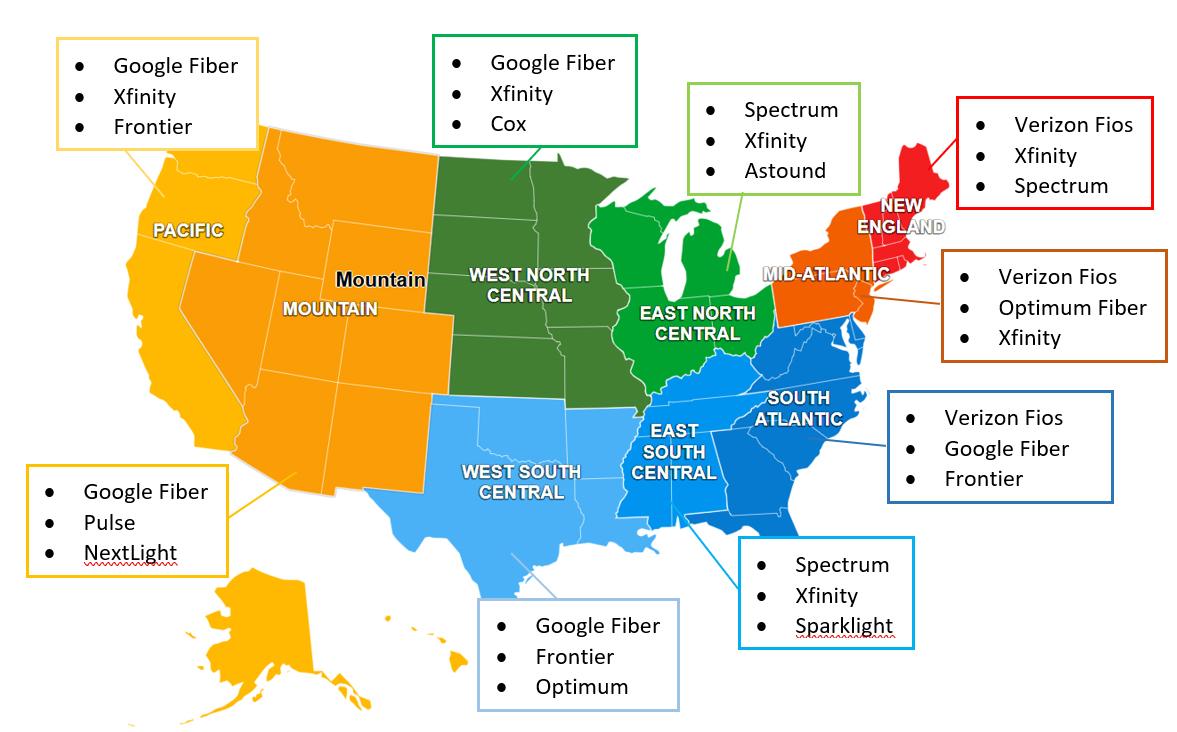
Top ISPs in different regions of the U.S. are ranked on the basis of speed/performance, coverage, price, and customer satisfaction. Data suggests that fiber and cable internet providers rule the urban markets nationwide.
FWA still has a smaller market share, but the rapid expansion of 5G networks might change that in the near future. Satellite internet from Starlink is largely popular in remote parts of the country, but deployment of fiber lines in these areas may transform rural connectivity.
Impacts of ISP Growth on the Market & Consumers
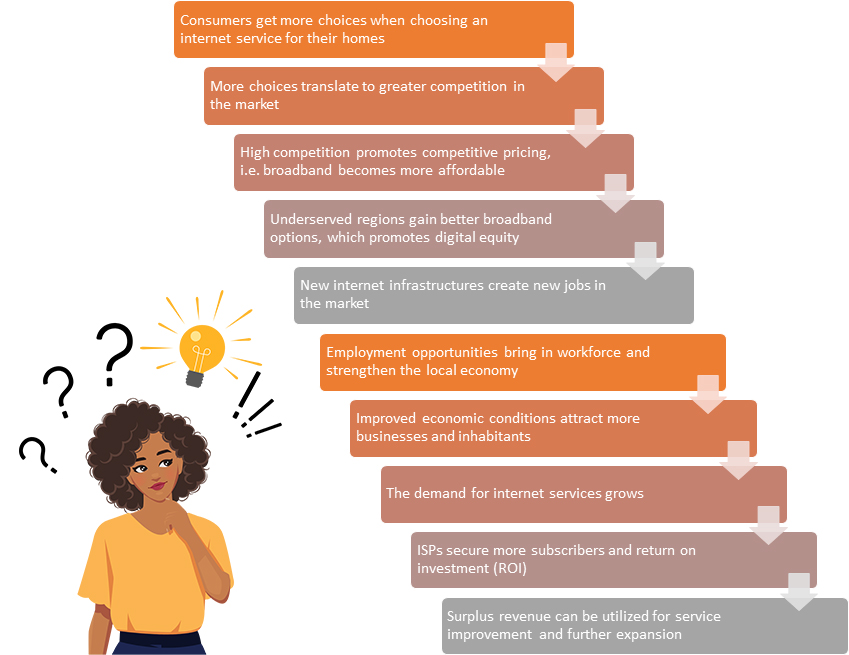
Here’s what ISP growth means for the consumers and the economy:
Challenges & Risks to Continued Growth
- Capital for expansion projects, as well as ongoing costs for maintenance and improvement of infrastructure, are difficult to manage with limited or no external funding.
- Legal/regulatory barriers, such as right-of-way (ROW) permit demands, prolonged approval processes, high municipal/franchising fees, compliance codes, and convoluted laws (federal, state, & local), add to hardships.
- Competition from other ISPs and alternative internet technologies minimizes room for profit; lowering prices becomes inevitable to stay in the race.
- Retaining customers is challenging in a competitive market; many users unsubscribe after the promotional period and switch to a cheaper service.
- Building, operating, and sustaining fiber networks requires skilled labor and specialized resources; a gap in the supply chain can disrupt entire systems.

Future Outlook/Predictions (2025–2030)
Internet demands will continue to rise in view of the growing web of Internet of Things (IoT), progressive AI applications, the rooted remote work culture, and other technological trends. Therefore, the need for faster and more reliable internet may never cease.
According to Fiber Broadband Association,, the average four-person household will require over 2 Gbps internet speed by 2030. To meet these exponentially growing demands, fiber and 5G internet carriers will have to expand and upgrade their networks simultaneously.
Right now, cable internet providers retain a major market share, but subscriptions have begun to decline. As the availability of affordable fiber and high-speed 5G Home Internet increases through BEAD funding and other government initiatives, older technologies might gradually disappear.
Recommendations for Stakeholders
For anyone wondering what their role is in expanding internet access and bridging the digital divide, here are a few suggestions:
For Consumers:
- Look out for FWA and fiber growth in your area
- Compare promotional offers and prices from different ISPs
- Assess long-term value of all available options by referring to ISP speed tests and experience reports
For ISPs:
- Prioritize investing in underserved areas
- Enhance user experience for existing customers to improve retention rates
- Consider partnerships or M&A to lower competition and enlarge footprint
For Policymakers:
- Support infrastructure funding to maintain growth momentum
- Encourage transparency in coverage and performance metrics
- Facilitate deployment of next-gen broadband through regulatory incentives
Can’t decide between Verizon, AT&T, Xfinity, or other internet options in your area?
Compare plans from the fastest-growing ISPs using our FREE Provider Comparison Tool
Frequently Asked Questions
Which ISPs are growing the fastest in the U.S. right now?
ISPs offering fiber and/or 5G FWA are flourishing right now. The majority of consumers are interested in replacing traditional broadband with one of these fast-growing internet technologies.
Why is 5G home internet growing so rapidly?
5G Home Internet subscription rates are on the high as many people are choosing it because of affordable pricing, hassle-free setup, and decent performance.
What role does fiber expansion play in ISP growth?
Fiber expansion gives ISPs a competitive edge in markets saturated by older/outdated broadband technologies. The high demand for fiber internet earns ISPs a good ROI and allows them to invest in further expansion.
How does government funding (BEAD) influence broadband growth?
BEAD is funding the construction of internet infrastructures in unserved and underserved regions of the country. The funding has allowed several ISPs to extend their network to rural/remote areas and offer service at affordable rates.
Is fixed wireless (5G) a good long-term option for home internet?
Fixed wireless (5G) can be a favorable option for long-term use, depending on your location and internet usage. However, it is typically recommended for renters and temporary setups because it is not as reliable as wired broadband.
Table of content
- Criteria for Ranking
- Top Fastest Growing ISPs in the U.S. (2025 Ranking)
- Growth Drivers: Why These ISPs Are Booming
- Fixed Wireless (5G)
- Fiber Expansion
- Infrastructure Funding
- Speed & Experience Gains
- M&A and Strategic Moves
- Regional Broadband Trends 2025
- Impacts of ISP Growth on the Market & Consumers
- Challenges & Risks to Continued Growth
- Future Outlook/Predictions (2025–2030)
- Recommendations for Stakeholders
- Frequently Asked Questions