
Peak Internet Usage Times in the US

Internet congestion is a situation where the user traffic exceeds the capacity of the network. This means too many users are competing for the available bandwidth, which results in slower speeds for everyone.
The network usually gets congested at peak internet usage times in the U.S., which occur after sunset. Internet peak time, also known as rush hour, may significantly impact the quality of streaming, gaming, and online work.
Does your internet’s performance go down at this time of the day?

We have analyzed data from the FCC, internet service providers (ISPs), traffic monitoring tools, and several case studies to bring you insights about the busiest internet hours in the U.S., as well as strategies to work around them.
What are Peak Internet Usage Times?
Peak internet usage times refer to the hours of the day when most people are online. Internet peak time in the U.S. is between 7 PM and 11 PM. The majority of internet users get off work by seven in the evening and mainly use the internet for entertainment purposes until bedtime.
On the other hand, off-peak internet usage times are the hours of the day when the least number of people are online. Off-peak time generally spans from late night to early morning, i.e., between 11 PM and 9 AM.
Weekday vs. Weekend Internet Usage Patterns
Peak hours may vary slightly during weekends, but are generally the same. Furthermore, the total user traffic on most networks is greater during peak hours on the weekend (Saturday – Sunday) as compared to typical working days (Monday – Friday).
Network traffic on the weekends typically remains high throughout the day and peaks in the evening; also, most of it comes from mobile devices.

How ISPs Measure Traffic Congestion
ISPs collect data from user routers, connection endpoints, and other network devices to monitor uptime, bandwidth, and latency.
Monitoring tools and deep packet inspection allow them to obtain traffic patterns and identify performance dips across their network at all times.
Internet Usage by the Hour in the U.S.
| Morning Usage (6 AM – 9 AM) |
Midday Usage (9 AM – 4 PM) |
Evening Peak Hours (7 PM – 11 PM) |
Late Night & Off-Peak Hours (12 AM – 6 AM) |
|---|---|---|---|
|
|
|
|
Tired of slow internet during peak and off-peak hours?
Consider switching to a Fiber-Optic Connection for faster & consistent speeds
Discover the Top Fiber Internet Providers Near You

What Causes Internet Congestion During Peak Hours?
Network traffic may exceed capacity during peak hours because that’s when the maximum number of people are online. When too many users on a shared network are competing for the limited bandwidth, congestion is caused by:
1. Streaming Platforms
Leading streaming platforms like Netflix, Disney+, and YouTube account for a major share of network traffic during peak internet hours. These streaming services take up ample bandwidth, as most subscribers prefer to view content in high resolution (HD/4K).
2. Online Gaming
Online gaming is among the primary drivers of network congestion, being a real-time, high-bandwidth activity; smooth gameplay demands high speeds and ultra-low latency. Multiplayer gaming is a popular hobby/pastime for many Americans, so traffic on gaming sites naturally surges during peak hours.
3. Remote Work & Video Calls
Work-from-home users often have the freedom to their jobs from anywhere at any time; hence, many choose evenings or nighttime rather than sticking to the traditional “9 to 5” schedule. Video calls/conferences and other sophisticated work applications tend to consume substantial bandwidth.
4. Smart Devices & Background Usage
The growing network of smart devices across U.S. households is partially responsible for network congestion, as they continuously consume internet resources in the background. The addition of smart home appliances and more gadgets per person demands more bandwidth.
Peak Internet Usage by Activity Type
| Activity | Internet Usage |
|---|---|
| Streaming (Netflix, YouTube, Live TV) |
SD: up to 0.7 GB per hour HD: up to 3 GB per hour 4K: up to 8 GB per hour |
| Gaming & Live Streaming (Fortnite, Call of Duty, etc.) |
50 - 300 MB per hour of gameplay (varies by game) Downloads & updates may consume up to 200 GB |
| Work-From-Home & Video Conferencing (Microsoft Teams, Google Meet, etc.) |
One-on-one video call: up to 350 MB per hour Group call/Video conference: up to 2.5 GB per hour |

Video buffering, game lags, and call drops even when speed tests show that the internet is working fine?
Chances are that your internet plan isn’t compatible with your household’s requirements
How Peak Hours Affect Internet Speed & Performance
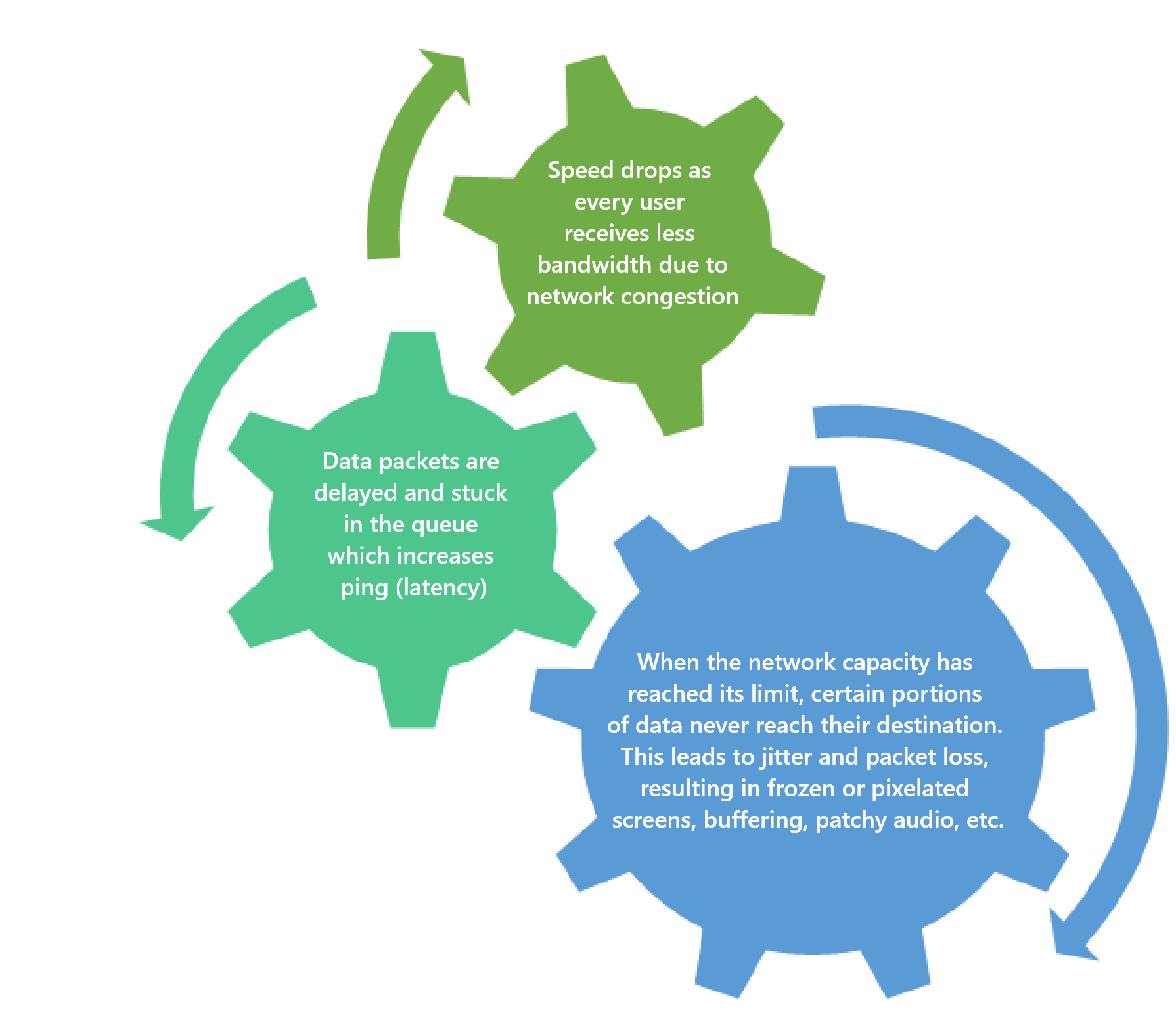
Using the internet during off-peak hours is one way to avoid network congestion, though it’s far from practical for most of us.
Since packet loss, ping, and jitter are primary causes of poor network performance during congestion, learn ways to fix them instead.

Do Peak Usage Times & Network Congestion Vary by Internet Type?
Peak broadband usage hours are roughly the same for households across the U.S., but how a home network copes with congestion may differ by the type of connection:
Cable Internet
Cable internet services have drastically improved over the years, and today it’s possible to achieve download speeds up to 2 Gbps. However, subscribers may have to share bandwidth with neighboring households, so network congestion and slower speeds can be expected during peak usage hours.
Fiber Internet
Fiber internet is capable of achieving the highest speeds and offers dedicated lines to all customers. Since users don’t have to share bandwidth with people outside their home network, the occurrence and impact of congestion are negligible.
5G & Fixed Wireless
5G mobile and fixed wireless connections rely on the same cell stations, i.e., they share bandwidth. 5G networks are prone to congestion during peak usage hours, so carriers may throttle speeds. 5G Home Internet users suffer more due to heavier bandwidth usage.
DSL & Satellite
DSL and satellite internet have limited bandwidth and a relatively low speed threshold. In spite of this, DSL is only slightly affected by network congestion because it uses a dedicated phone line. On the contrary, satellite internet is often subject to tight data caps and throttling, which may worsen performance during high traffic hours.
How to Avoid Slow Internet During Peak Hours
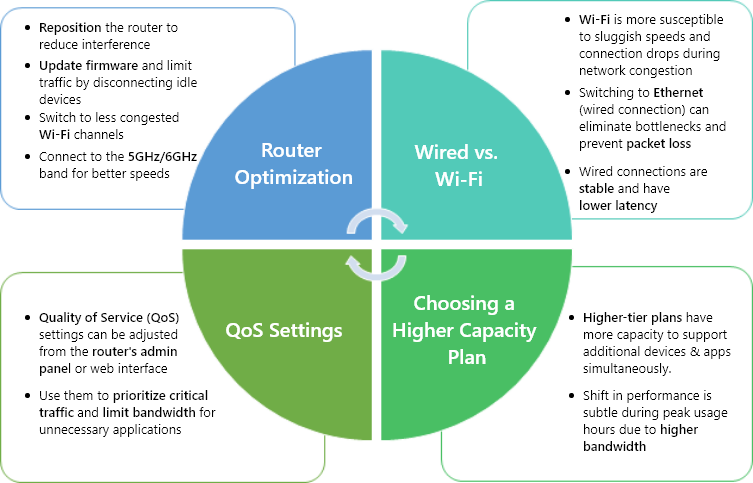

Can’t switch to Ethernet? That’s okay!
Try boosting your Wi-Fi speeds instead.
Check Out:
Key Takeaways: Peak Internet Usage in the U.S.

Frequently Asked Questions
What time is the internet most congested in the US?
Internet is most congested during peak usage times in the U.S. which are between 7 – 11 PM.
Is internet slower at night?
Yes, internet is slower around night time, as user traffic is high between 7 – 11 PM. Speeds get better after midnight (12 AM) when most users log off to go to bed.
Are weekends worse for internet speed?
Network traffic is comparatively higher on the weekends, which is why internet speeds can be slower than usual.
Does fiber slow down during peak hours?
Fiber internet is not susceptible to network congestion as it has higher bandwidth and dedicated lines for all users.
What is the best time to use the internet for faster speeds?
Internet speeds during late night & off-peak hours (12 AM – 6 AM) are faster, as network traffic is the lowest at these times. Therefore, these are the best hours to pursue high-bandwidth activities such as 4K streaming, multiplayer gaming, and large downloads/uploads.