
Wi-Fi 6 vs. Wi-Fi 5: a battle of two generations. Will the new and improved generation win? Let’s find out!
When it comes to technology, the newer version is almost always considered better. Picture this: you’re already using Wi-Fi 5, so moving forward would entail embracing Wi-Fi 6 – makes sense?
Faster Wi-Fi is an incentive nobody would refuse, though upgrading to a higher Wi-Fi standard is more than that. The question is whether you’re ready for all of it?
Brief History of Wi-Fi Standards
The first Wi-Fi standard created by the Institute of Electrical and Electronics Engineers (IEEE) in 1997 was named “802.11”. The succeeding versions were named as amendments to the original, for example, 802.11a, 802.11g, 802.11n, and so on.
Each progressive version brought greater data transfer capabilities, thanks to wider bandwidth and the addition of another frequency band (i.e., more Wi-Fi channels).
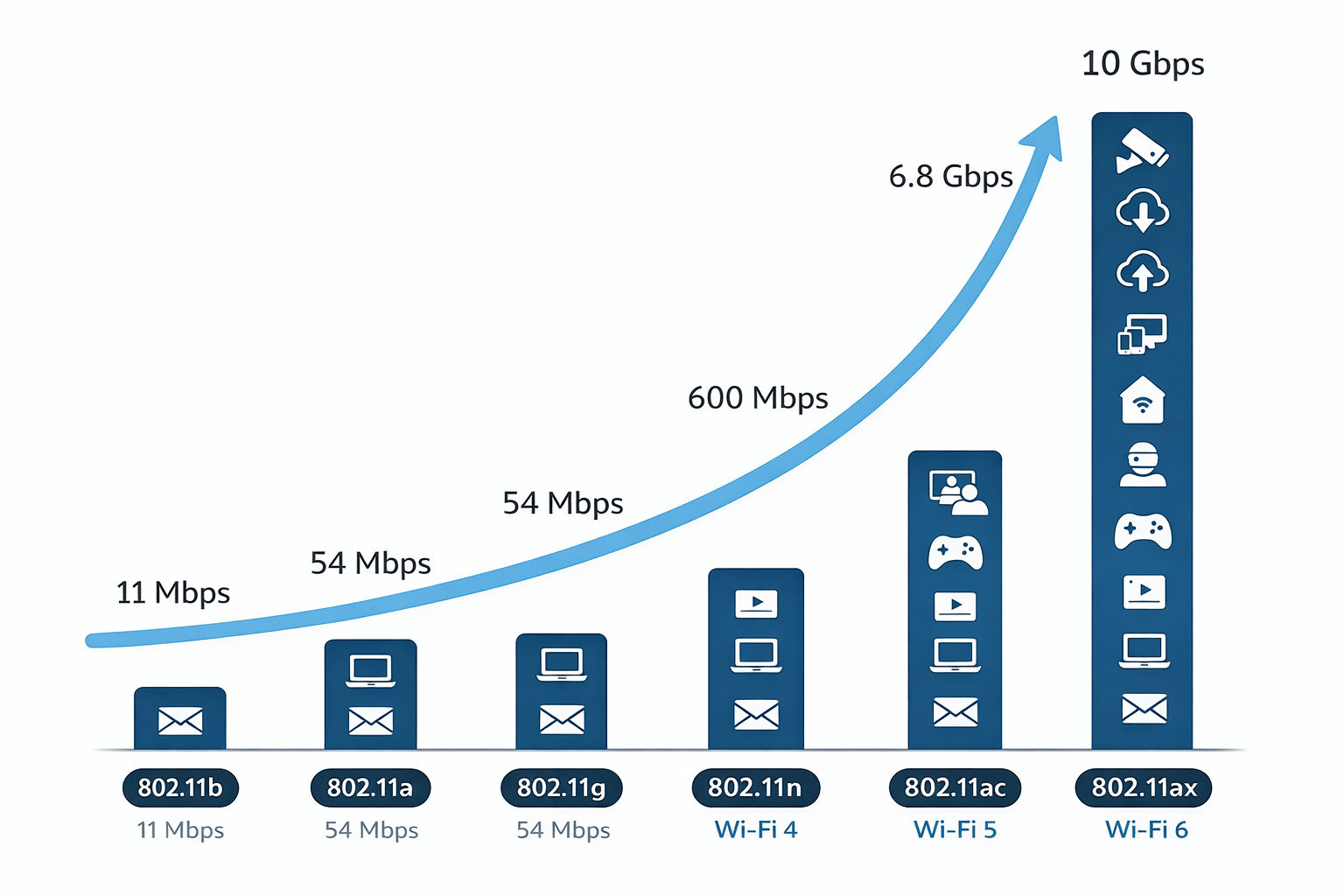
Timeline of Major Wi-Fi Standards:
| Wi-Fi Standard | Year of Release | Frequency Bands | Max. Speed |
|---|---|---|---|
| Wi-Fi 4 – 802.11n | 2009 | 2.4 GHz & 5 GHz | 600 Mbps |
| Wi-Fi 5 – 802.11ac | 2013 | 5 GHz | 3.5 Gbps |
| Wi-Fi 6 – 802.11ax | 2019 | 2.4 GHz & 5 GHz | 10 Gbps |
While Wi-Fi 6 is a widely employed Wi-Fi standard in modern routers, it is not the latest. Wi-Fi 6 was followed by Wi-Fi 6E in 2020, which offers an additional 6 GHz frequency band; although maximum speed capacity is identical.
Wi-Fi 7 was introduced in 2024, and is equipped with three frequency bands (2.4 GHZ, 5GHz, & 6 GHz) like Wi-Fi 6E. However, the speed potential is much greater on paper (up to 46.1 Gbps), which is promising for the future.
What is Wi-Fi 5?
Wi-Fi 5 (IEEE 802.11ac) is the 5th generation of Wi-Fi standards and solely runs on the 5 GHz frequency band. While theoretical speeds are claimed to be as high as 3.5 Gbps, the maximum speeds achieved practically are much lower.
🟢 Strengths:
- First Wi-Fi standard with multiple input/multiple output (MIMO) technology, which resulted in stronger signals and higher throughput.
- Utilizes a less-congested frequency channel (5 GHz).
- Much more efficient than previous Wi-Fi generations.
🔴 Limitations:
- Limited Wi-Fi coverage as signals from the 5 GHz band cannot travel long distances.
- Does not support devices that are only configured for the 2.4 GHz band.
What is Wi-Fi 6?
Wi-Fi 6 (IEEE 802.11ax) is the 6th generation of Wi-Fi standards that utilizes both the 2.4 GHz and 5 GHz frequency bands. Wi-Fi 6 routers are designed to increase network capacity, improve speeds, enhance security, lower latency, and support high-bandwidth activities on a wider range of devices.
🟢 Strengths:
- Equipped with Orthogonal Frequency Division Multiple Access (OFDMA), which creates subdivisions of Wi-Fi channels to maximize data transfer rates
- Includes Target Wake Time (TWT) that prolongs battery life
- Multi-user, multiple input, multiple output (MU-MIMO) technology
- WPA3 – advanced network security
🔴 Limitations:
- Compatibility issues on older devices
- Relatively expensive
Wi-Fi 5 vs. Wi-Fi 6: Key Differences
| Feature | Wi-Fi 5 (802.11ac) | Wi-Fi 6 (802.11ax) |
|---|---|---|
| Max. Speed | ~3.5 Gbps | ~10 Gbps |
| Frequency Bands | 5 GHz only | 2.4 GHz + 5 GHz |
| Technology | Limited | High |
| Device Capacity | SU-MIMO | OFDMA + MU-MIMO |
| Battery Efficiency | Standard | Target Wake Time (TWT) |
| Security | WPA2 | WPA3 |
Should You Upgrade to Wi-Fi 6?
In summary, Wi-Fi 6 is built for super-sonic speeds and extended Wi-Fi coverage. It takes wireless internet connectivity to the next level by accommodating more high-bandwidth activities and cutting-edge devices. Does that sound like something you need?
Upgrade if:
- You have many smart devices and latest gadgets
- You prefer to stream or game in 4K
- You're subscribed to 500 Mbps or faster internet

Wait if:
- Your current setup works fine for everyday internet usage
- Your devices don’t support Wi-Fi 6 yet
- Your internet plan delivers speeds below 500 Mbps
Bonus: What Is Wi-Fi 6E?
Wi-Fi 6E is an extension of Wi-Fi 6, which means they share the same standard, i.e., 802.11ax. Wi-Fi 6 routers are “dual-band”, as they operate on two frequency bands (2.4 GHz & 5GHz). On the other hand, Wi-Fi 6E routers comprise a third 6GHz frequency band, which makes them “tri-band”.
The inclusion of the 6 GHz band adds extra bandwidth; hence, greater speeds and lower latency are a given. The Wi-Fi 6E technology has the potential to support heavier network traffic and ultra-high bandwidth applications, such as 8K streaming.
Recommended Internet Plans for Wi-Fi 6
Have you decided to upgrade to Wi-Fi 6 to experience advanced wireless connectivity? In that case, get the most out of your Wi-Fi 6 router by pairing it with a fast and reliable internet plan. Gig-speed internet is the way to go, so consider these amazing options:
| ISP | Internet Plan | Max. Download Speed | Monthly Charges | How to Subscribe |
|---|---|---|---|---|
 | Fiber 1 Gig | 1 Gbps | $701 | ORDER NOW |
 | 1 Gig | 1000 Mbps | $852 | ORDER NOW |
 | 1 Gig Internet | 1000 Mbps | $703 | ORDER NOW |
 | Spectrum Internet® Gig | 1 Gbps | $604 | ORDER NOW |
 | Internet 1 Gig | 1 Gbps | $655 | ORDER NOW |
1. Plus taxes & fees for 12 mos. Price + taxes & fees for new customers after discounts w/elig AutoPay & Paperless bill. Ltd. avail/areas.
2. With Autopay and Paperless Discount For 60 month, no term contract. Taxes and equipment not included. Incl. up to $10/mo. auto-pay & paperless bill discount.
3. w/ $10 ACH Autopay discount for Internet and/or Video services. In select markets only.
4. For one year
See Offer Details for terms and conditions
5. For 2 years plus one-time charges, tax & gov’t fees. Offer Details
Wrapping Up
Upgrading from Wi-Fi 5 to Wi-Fi 6 is the right idea if you’re constantly let down by the poor performance of your internet connection. Heavy internet users and big households with a large number of smart devices can benefit from more advanced Wi-Fi technology.
The shift to Wi-Fi 6 is suggested to future-proof your home network. Your speed needs are likely to increase with the addition of new smart home appliances and cutting-edge gadgets over time. If it’s time to say goodbye to your current router, why not reach for the next best thing?
FAQs
What are the Wi-Fi 6 benefits?
Compared to older Wi-Fi generations, Wi-Fi 6 offers:
- Faster speeds
- Greater network capacity
- Better security features
Wi-Fi 6 speed vs Wi-Fi 5 speed: Which is better?
Wi-Fi 6 can support internet speeds up to 10 Gbps, whereas Wi-Fi 5 only goes as far as 3.5 Gbps under ideal conditions. While Wi-Fi 6 is definitely faster, you won’t notice the difference unless your internet connection offers more than 500 Mbps speed.
What is the difference between Wi-Fi 5 and Wi-Fi 6?
The main difference between Wi-Fi 5 and Wi-Fi 6 is that the latter has an additional frequency band. Wi-Fi 5 only offers the 5 GHz frequency band, whereas Wi-Fi 6 is equipped with the 2.4 GHz and 5 GHz frequency bands. The dual-band feature of Wi-Fi 6 allows greater Wi-Fi range, more bandwidth, and improved speeds.


